Not every move goes from front door to front door in one clean day. Chain delays, key handovers running late, renovation work at the new address, or a rental gap between tenancies mean thousands of Scottish homeowners each year need somewhere to put their furniture and boxes for a few days or a few weeks. This guide covers when storage between moving dates is worth the cost, when it is not, what to store and what to keep with you, how to pack for storage, and how removals and storage fit together. Use what applies to your situation.
When You Need Storage Between Moves
If your move-out and move-in dates fall on the same day and completion goes to plan, you probably do not need storage. Everything gets loaded in the morning, driven across town, and unloaded that afternoon. The trouble starts when the two dates do not line up. Here are the situations we see most often across Scotland.
Delayed Keys
Solicitors miss a completion deadline. Funds do not clear by 2pm on a Friday. The seller’s onward property falls through at the last minute. In each case, you have moved out but cannot move in yet. This is the most common storage trigger by a wide margin.
Chain Delays
Property chains are unpredictable. A slip anywhere in the chain can push completion back by days or even weeks. If your buyer needs to move in but your seller has not moved out, storage is the buffer.
Renovation or Fit-Out Work
The new property needs painting, flooring, a new kitchen, or damp work before furniture can go in. Rather than move heavy items in and then shuffle them room to room during works, most people store while the work happens.
Downsizing
If you are moving to a smaller property, some furniture will not fit. Storage buys you time to decide what to keep, sell, gift, or donate without the pressure of doing it on move day itself.
Waiting for a New-Build Completion
New-build completion dates can slip by weeks. If you sold your existing property first (a common requirement from mortgage lenders), storage is the bridge.
Rental Gap Between Tenancies
Your current tenancy ends before the new one starts. Or you are moving into short-term rented accommodation while you continue looking for a permanent home.
Relocation Timing
Moving to a new job in a different part of Scotland or moving abroad and shipping later. Furniture needs to sit safely until you are ready.
When You Probably Do Not Need Storage
Storage is a cost. If you do not need it, do not book it. You probably do not need storage between moves if:
- Move-out and move-in are on the same day, with completion realistically confirmed in writing.
- Your new property is ready to receive furniture as soon as you arrive.
- You are staying with family for a short overlap and can keep essentials in your vehicle.
- You are moving locally with a very small property and can do multiple trips in one day.
If you are unsure, ask your removal company at the quote stage. A good firm will tell you honestly whether storage is worth booking or not.
Short-Term vs Longer Storage
The right storage length depends on why you need it. Rough guidance based on what we see:
Short-Term (1 day to 4 weeks)
For completion gaps, chain delays, and short renovation windows. Items are collected, stored, and delivered back within a few days or weeks. Same-team collection and redelivery keeps costs down.
Medium-Term (1 to 6 months)
For downsizing decisions, waiting on a new-build, or an extended renovation. You may want partial access during this period to retrieve specific items. Flag this at the quote stage so we plan for it.
Long-Term (6 months or more)
For relocations, working abroad, moves to short-term rentals while a purchase completes, or holding furniture during major life transitions. Long-term bookings are quoted separately and often work out cheaper on a per-month basis than short-term.
Full details on our secure storage facility at Victoria Works in Johnstone.
What to Store and What to Keep With You
Fine to Store
- Furniture: sofas, beds, wardrobes, dining tables, chairs
- White goods (drained and defrosted at least 24 hours in advance)
- Electronics in original boxes or well-padded (TVs, computers, hi-fi)
- Kitchenware, glassware, and crockery in properly packed boxes
- Books, DVDs, and non-perishable belongings
- Bikes, garden furniture, tools (petrol drained)
- Non-essential clothes, bedding, and linen
Do Not Store
- Food or perishables of any kind (invites pests and mould)
- Plants (they will die)
- Aerosols and flammable liquids (paint, petrol, propane, lighter fluid, some cleaning products)
- Batteries connected to devices (they leak over time)
- Live cultures, opened wine, or anything fermenting
- Cash, jewellery, or high-value small items (keep on you)
- Original passports, birth certificates, or wills (keep on you)
- Medication or prescriptions (keep on you)
- Firearms, ammunition, or anything requiring a licence
Keep With You Throughout the Gap
- Overnight bag: change of clothes, toiletries, phone charger
- Kettle, mugs, cutlery for essentials
- Any medication or ongoing prescriptions
- Important documents you might need mid-move (contracts, insurance details)
- Children’s and pets’ essentials
Packing for Storage
Packing for storage is slightly different to packing for a same-day move. Items are being handled twice (in and out), sit stationary for days or weeks, and are stacked. A few practical points:
- Use proper boxes, not carrier bags or bin liners. Boxes stack safely. Bags sag and split.
- Do not overfill boxes. A box you cannot lift is a box the crew has to open and rebalance. Keep box weights around 15 kg maximum.
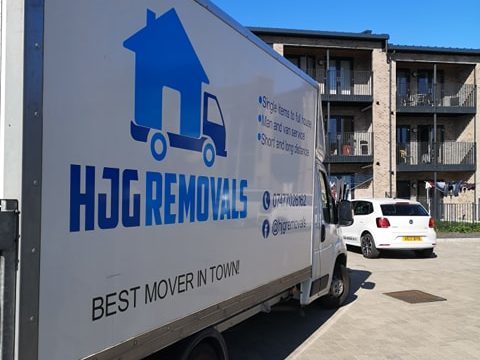
- Wrap furniture properly. HJG uses padded covers on sofas, mattresses, and larger items as standard. Ask about this if you are booking with another firm.
- Label everything clearly. Room name, contents, and priority (“open first”, “long-term hold”). You may not remember what is in a box after four weeks.
- Photograph large items before storage. Helps identify any damage claim later.
- Drain and dry white goods. Fridges and washing machines that go into storage wet grow mould. Give them 24 to 48 hours to fully dry.
- Remove batteries. Any device with batteries (remotes, clocks, torches) should have them removed to prevent leakage.
If HJG is packing for you, we handle all of the above as standard. Full details on our packing service.
How Removals and Storage Work Together at HJG
Booking both with one company is simpler and usually cheaper. Here is how it works with HJG:
- Single quote. You get one fixed price covering collection at the old address, storage for the agreed duration, and delivery to the new address.
- Single crew. The same team that loads at the old property loads it into storage and later delivers it to the new one. No second handover.
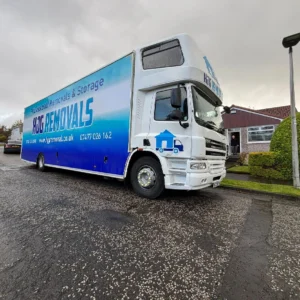
- Single vehicle. Items are collected in our lorry, driven straight to our facility, and stored without transfer to another crew or unit.
- Same insurance cover. One insurance policy covers loading, transport, storage, and delivery.
Our facility is at Victoria Works in Johnstone, in the heart of Renfrewshire. It is HJG’s own base, not a third-party unit. That means shorter collection windows for customers in Paisley, Johnstone, and the wider central belt.
Common Moving-Date Problems and What to Do Next
The Situation | The Practical Next Step |
Completion delayed by 24 hours | Book short-term storage (1 to 3 days). Cheaper than rebooking removals. |
Chain slipped, gap of 1 to 2 weeks | Short-term storage plus a place to stay (family, hotel, short-let). Book both quickly. |
New property needs painting or flooring | Store for the duration of works. Estimate generously (jobs run late). |
Downsizing to a smaller property | Store the “keep or sell” items separately. Set a decision deadline. |
New-build completion date slipping | Medium-term storage. Ask for a rolling monthly quote. |
Rental gap between tenancies | Short to medium storage. Coordinate collection with lease end. |
Moving abroad, shipping later | Long-term storage. Confirm access windows for retrieval. |
Bereavement or estate clearance | Sensitive short to medium storage. HJG handles these routinely, flag at the quote stage. |
Storage Useful vs Not Needed: Quick Check
Your Situation | Storage Recommendation |
Same-day move, completion confirmed in writing | Not needed |
Same-day move, completion not yet confirmed | Book contingency short-term as a backup, cancellation usually free |
Any gap of 24+ hours between move-out and move-in | Book short-term |
Downsizing, need time to decide what to keep | Book medium-term with access |
New property under renovation | Book for full duration of works plus 1 week buffer |
Moving abroad or into short-term rental | Book long-term with periodic review |
Small move within town, one vehicle, half-day | Usually not needed |
Buyer wants fast completion, your onward move not confirmed | Book short-term, gives you time to complete the onward purchase without pressure |
What to Send HJG for a Removals-and-Storage Quote
The more you send in your first message, the faster we come back with an accurate fixed price:
- Old address in full (with floor number if a flat)
- Rough inventory (bedroom count or item list)
- New address if known (or “TBC” and when you expect to know)
- Preferred collection date
- Expected storage duration (or “unknown, please quote a rolling monthly rate”)
- Whether packing is required
- Any items you may need access to during storage
- Any specialist items: piano, safe, artwork, gym equipment
Request a removals and storage quote or call 0141 534 6098.
FAQs: Storage Between Moving Dates
Do I really need storage between moving dates?
Only if there is a genuine gap between moving out and moving in. If your dates line up on the same day, storage adds cost you do not need. If completion is delayed by even 24 hours, or you have a two to seven day gap between properties, storage is the practical option. HJG collects from your old address, holds items securely, and delivers when your new property is ready.
How much does short-term removals storage cost in Scotland?
Cost depends on volume and length of storage. HJG provides fixed-price quotes covering collection, storage, and redelivery in one figure. There is no minimum contract, so a two-day hold is charged accordingly.
What should I not put into storage during a move?
Do not store food, plants, perishables, live cultures, aerosols, flammable liquids, batteries connected to devices, or original important documents (passports, birth certificates, wills). Keep valuables, medication, and daily-use items with you. Anything you might need before the new property is ready should stay accessible.
Do removals and storage need to be booked together?
It saves time and money if you book both with the same company. Booking removals and storage separately means two crews, two vehicles, and two sets of handling. HJG covers both from the same base in Johnstone, so items are collected, stored, and redelivered by the same team.
How long can I store items with HJG between moves?
As long as you need. There is no minimum or maximum. Short-term bookings of a few days are just as welcome as long-term bookings that run for months. Full CCTV monitoring throughout, no minimum contract.
Need Storage Between Your Moving Dates?
Tell us your collection date, rough property size, and how long you might need storage. We will come back with a fixed price covering the whole thing: collection, storage, and delivery to your new address.
Get a quote or call 0141 534 6098. Full details on our house removal service and storage facility.